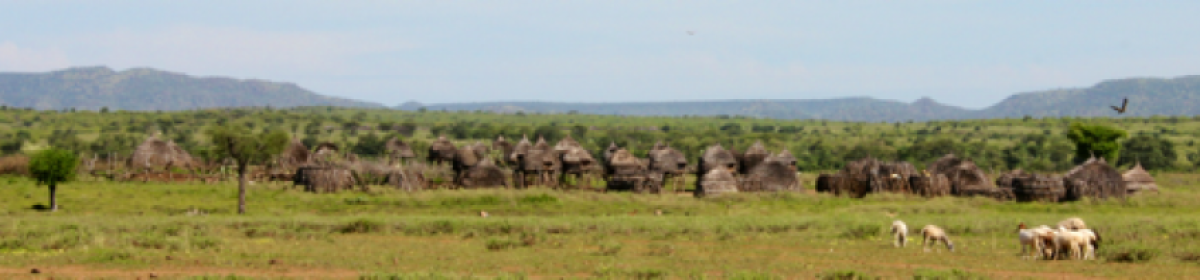
Narus from on high

I have become good friends with two girls with whom I go walking to the top of the hill above Narus. I don’t think it has a name but it is the best vantage point from which to survey Narus.

When we go walking sometimes Lucy carries her 18 month old son Nicholas. She carries him on her back fastened in her wrap in the traditional African way. I’m always astounded by how fit she is, she almost runs up the hill while Anna and I hike after her, counting every step in the heat! 

From the top of that hill we can see Uganda, Kenya and Ethopia. The land around is flat, dry and dusty. There are hills here and there but typically the land is very flat. Until the two telecommunications boosters were constructed in Narus this was the only place where mobile signal was to be found. In order to make a call, people would have to hike to the top and search for a strong signal. And to think unused to complain about my signal in Fulham!

From the top of the hill, we can also see many of the surrounding Toposa villages. Narus itself is a melting pot of all different tribes. Tousands of people came to Narus during the war and stayed. It was close to the border so it was considered safe and it was also a strategic base for the SPLA.

One thing that struck me on my travels in South Sudan is the absence of animals. I have now lerned that South Sudan was once a thriving ecosystem with many large animals such as elephant, monkey, rhinoceros, giraffe, impala, zebra, lion and leopard. However, the animals are gone now. During the way many were hunted and  killed for meat when there was nothing else to eat. They say that many fled to Uganda for safety scared by the noise of the guns and shells.

The land is so dry here and we are praying for rain. The crops are endanger of failing. The staple here is a grain similar to maize called sourkhum. In different places around Narus you can see where small gardens of sourkhum have been planted but the crop is burning.

The funeral of Donna Kulang Yiko

This post is long over due and it has been sitting in my drafts since my first day in Narus. This was a difficult post to write. 

We had left Lokichoggio early on the morning of Saturday September 7th arriving at the border and crossing safely. The journey from Nadapal which is the town at the border to Narus takes about 45 minutes. 

We arrived, I got settled in and we met for a nice cup of tea. Fr. Tim and Fr. John Joe had been asked to say funeral prayers for a local girl who had died at the age of just 13. We travelled the short distance to the family’s small compound and I felt a little unsure of what to expect. At one end of the compound, a makeshift shelter had been constructed to protect from the punishing afternoon sun. An altar had been placed under the shelter facing the main enclosure of the compound.

I think there may have been about 100 people in the small compound and after greeting the parents of the dead girl we were directed to sit under the shelter. I was struck that with the exception of me and the Headmistress of St. Bakhita Primary School, the shelter was exclusively for men. It became clear that Sister. Margaret and I had been afforded the position of guests at the prayers. All the other women sat on wraps laid on the dusty ground in the centre of the compound, finding what shade they could.

Fr. Tim led the prayers and it amazed me to hear him relate so effortlessly to the family in both Juba Arabic and the local Toposa dialect. It was a simple ceremony with beautiful music provided by some of my now students and other members of the church here.

I knew that the girl had died about two weeks before and I’m not sure whether I expected to see a casket or not but I do remember wondering whether Kulang had already been buried and if so, where.

The answer came immediately after the funeral mass was over. Fr. Tim went to bless the compound and the grave. When he walked towards the corner of the compound where Kulang was buried there was a flurry of activity to clear the way for him. I found it hard to come to terms with the fact that the young girl had been buried almost immediately just a few feet from where she had grown up with her grandmother. Tradition (and I suppose practicality) demands that once a person dies here they must be buried as soon as possible. Tim blessed each of the other buildings in the compound before returning to hear the addresses by the elders of the various tribes in attendance. 

The addresses were given in Arabic or Toposa and were translated as necessary. One in particular struck me so deeply. One woman who represented the elders of what I think was the Dinka tribe said that the only reason that the family should grieve was because Kulang had not left a child. This girl was thirteen years old. This was my first real taste of how young girls are perceived in South Sudan.

There were a number of other addresses and about 45 minutes later we were invited to wash our hands and share a meal. Tim and John Joe were directed to an urn from which clean water flowed to wash hands before being served a meal fit for a king. I was instructed to follow the priests and Sister Margaret followed me.

The food was incredible. I have absolutely no idea what it was but we ate with our hands and licked our fingers clean!

I admit to feeling somewhat uncomfortable with my position of guest, I felt more like an intruder or voyeur on this day in the family’s life. I’m very grateful for their hospitality though and for their welcome.

Things I’ve learned in Kenya and South Sudan

1. And this is by far the most important….when Fr. Tim says “I don’t want to scare you but…” The sentence normally ends with something about man eating snakes, spiders with killer bites, scorpions or land mines and so a sensible amount of terror is prudent.

2. In regional airports, there is no check-in. Go to the nearest bar and wait there until you see the plane land. This is the equivalent of having the gate announced. At any rate, it will take them a few minutes to clear the runway of cattle, sheep and goats so you’ll have plenty of time!

3. I can survive without chocolate, wine and my hair straighteners.

4. I am the only person in the world for whom DEET does not work. I am covered in bites and I think every small bug in South Sudan, Kenya and Uganda has had a chomp on some part of me.

5. I will be very happy never to see another bowl of porridge.

6. Using my ipad under the mosquito net at night is a bad idea.

7. That no matter how many times I ask, Tim is not going to allow me to drive the motor bike.

8. It is almost completely pointless to arrive anywhere at the time you’re supposed to be there. Nothing happens here for at least an hour after its supposed to have happened.

9. The cat and I will never be friends.

10. You can always depend on Fr. John Joe to brew an award winning cup of tea.

11. Always keep your eyes open and your mouth closed in the shower 🙂