Narus from on high

I have become good friends with two girls with whom I go walking to the top of the hill above Narus. I don’t think it has a name but it is the best vantage point from which to survey Narus.

When we go walking sometimes Lucy carries her 18 month old son Nicholas. She carries him on her back fastened in her wrap in the traditional African way. I’m always astounded by how fit she is, she almost runs up the hill while Anna and I hike after her, counting every step in the heat! 

From the top of that hill we can see Uganda, Kenya and Ethopia. The land around is flat, dry and dusty. There are hills here and there but typically the land is very flat. Until the two telecommunications boosters were constructed in Narus this was the only place where mobile signal was to be found. In order to make a call, people would have to hike to the top and search for a strong signal. And to think unused to complain about my signal in Fulham!

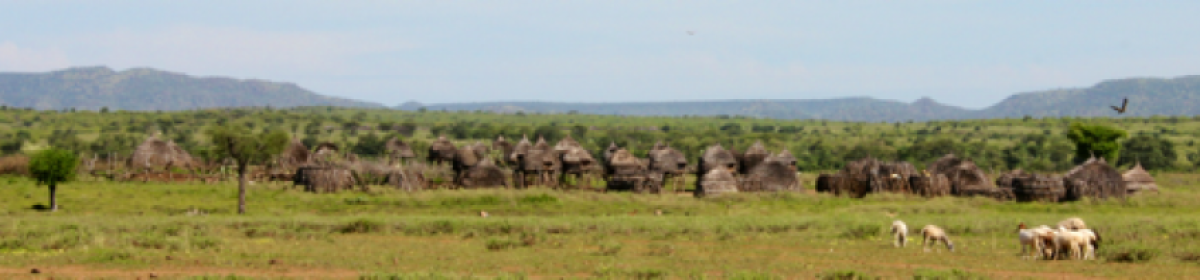
From the top of the hill, we can also see many of the surrounding Toposa villages. Narus itself is a melting pot of all different tribes. Tousands of people came to Narus during the war and stayed. It was close to the border so it was considered safe and it was also a strategic base for the SPLA.

One thing that struck me on my travels in South Sudan is the absence of animals. I have now lerned that South Sudan was once a thriving ecosystem with many large animals such as elephant, monkey, rhinoceros, giraffe, impala, zebra, lion and leopard. However, the animals are gone now. During the way many were hunted and  killed for meat when there was nothing else to eat. They say that many fled to Uganda for safety scared by the noise of the guns and shells.

The land is so dry here and we are praying for rain. The crops are endanger of failing. The staple here is a grain similar to maize called sourkhum. In different places around Narus you can see where small gardens of sourkhum have been planted but the crop is burning.

The funeral of Donna Kulang Yiko

This post is long over due and it has been sitting in my drafts since my first day in Narus. This was a difficult post to write. 

We had left Lokichoggio early on the morning of Saturday September 7th arriving at the border and crossing safely. The journey from Nadapal which is the town at the border to Narus takes about 45 minutes. 

We arrived, I got settled in and we met for a nice cup of tea. Fr. Tim and Fr. John Joe had been asked to say funeral prayers for a local girl who had died at the age of just 13. We travelled the short distance to the family’s small compound and I felt a little unsure of what to expect. At one end of the compound, a makeshift shelter had been constructed to protect from the punishing afternoon sun. An altar had been placed under the shelter facing the main enclosure of the compound.

I think there may have been about 100 people in the small compound and after greeting the parents of the dead girl we were directed to sit under the shelter. I was struck that with the exception of me and the Headmistress of St. Bakhita Primary School, the shelter was exclusively for men. It became clear that Sister. Margaret and I had been afforded the position of guests at the prayers. All the other women sat on wraps laid on the dusty ground in the centre of the compound, finding what shade they could.

Fr. Tim led the prayers and it amazed me to hear him relate so effortlessly to the family in both Juba Arabic and the local Toposa dialect. It was a simple ceremony with beautiful music provided by some of my now students and other members of the church here.

I knew that the girl had died about two weeks before and I’m not sure whether I expected to see a casket or not but I do remember wondering whether Kulang had already been buried and if so, where.

The answer came immediately after the funeral mass was over. Fr. Tim went to bless the compound and the grave. When he walked towards the corner of the compound where Kulang was buried there was a flurry of activity to clear the way for him. I found it hard to come to terms with the fact that the young girl had been buried almost immediately just a few feet from where she had grown up with her grandmother. Tradition (and I suppose practicality) demands that once a person dies here they must be buried as soon as possible. Tim blessed each of the other buildings in the compound before returning to hear the addresses by the elders of the various tribes in attendance. 

The addresses were given in Arabic or Toposa and were translated as necessary. One in particular struck me so deeply. One woman who represented the elders of what I think was the Dinka tribe said that the only reason that the family should grieve was because Kulang had not left a child. This girl was thirteen years old. This was my first real taste of how young girls are perceived in South Sudan.

There were a number of other addresses and about 45 minutes later we were invited to wash our hands and share a meal. Tim and John Joe were directed to an urn from which clean water flowed to wash hands before being served a meal fit for a king. I was instructed to follow the priests and Sister Margaret followed me.

The food was incredible. I have absolutely no idea what it was but we ate with our hands and licked our fingers clean!

I admit to feeling somewhat uncomfortable with my position of guest, I felt more like an intruder or voyeur on this day in the family’s life. I’m very grateful for their hospitality though and for their welcome.

A short visit to Kapoeta

I’m currently in Riwoto visiting John Marren with Tim and John Joe. We drove up together and met John in Kapoeta in the early afternoon. Our pick-up was full with those who had business to do in Kapoeta. It’s about two hour bone shaking drive on terrible roads from Narus to Kapoeta, a fact which became very real when I realised that only services for pregnant women only recently became available in Narus.

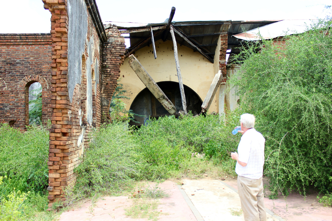
We visited Fr. Tims old parish church which has been destroyed by the Arabic Khartoum government. It was quite moving to see how the church had been desecrated.

From there we had a quick lunch at the Kapoeta “Ritz”…the less said about that the better…suffice to say I saw them skin our lunch….

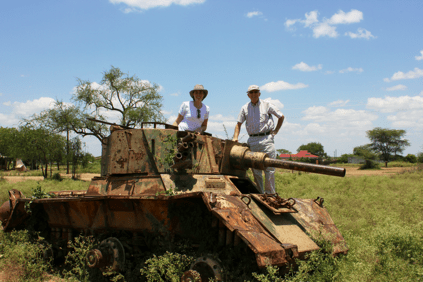
I will leave you to learn the history of Kapoeta yourself but it was ravaged by way and the remnants are still scattered around. It’s all very fine taking pictures and making fun as we did below but the reality is rather more serious. There are still land mines which frequently cause destruction and death scattered around the countryside.

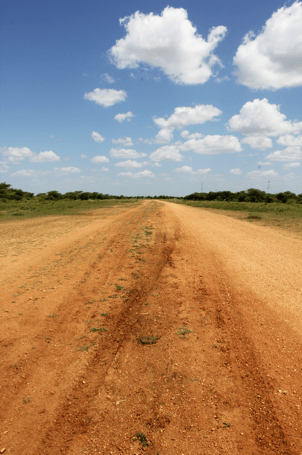
We then drove to Riwoto which was another bone shaking drive. The highlight of which was the part of the route that took us directly down the runway of Kapoeta airport. This airport is still in use. There are people employed to clear the runway from cars and animals when a plane comes in to land. Often a plan will have to enter into a holding pattern until the runway is clear!

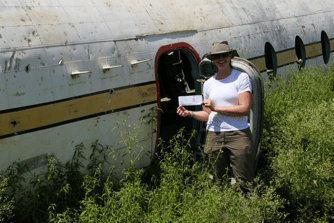
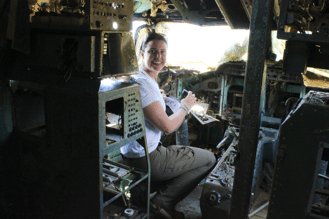
Another remnant from the war below – I was lucky to have remembered my boarding pass!

Welcome to South Sudan Helena Eireannach

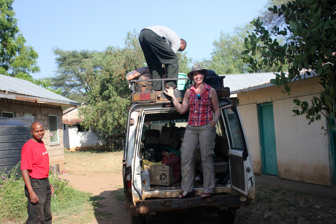
We left on the final leg of our long journey to Narus on The morning of Saturday Septemer 7th. Our jeep was packed full but thankfully there were no punctures to delay us!

First arriving at the Kenyan border we were “checked out” of Kenya before continuing the mile or so to the South Sudan border. Not only crossing country borders, we were crossing from Turkana territory to Toposa territory. The two tribes have a history of war but there is peace now and this is a great relief to both tribes.

Outside the Kenyan border control. A young Turkana woman sat with a small purse. She entered into a colourful conversation with John Marren and it was a little while before I realised that this was the Kenyan borders answer to a Bureau de Change! There was a lot of negotiation but eventually the two parties came to a deal. Fr. John walked away and commented to me “now that’s what I call outsider trading”!

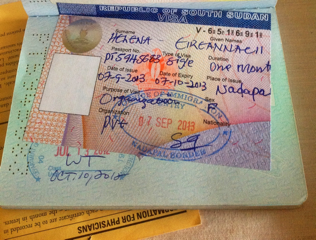
We continued to the South Sudan border and while Fr. Tim mad the necessary arrangements to get the truck across the border John Marren accompanied me to get my Visa. After what seemed like an eternity (despite the excellent company I hasten to add) and $100 later I was the proud owner of a South Sudan residents permit valid for one month. Visas are only issued monthly and it’s $100 each time….nice work if you can get it!!!

It was a jubilant return and there were celebratory hugs when Fr. Tim officially welcomed me to South Sudan. I was on his turf now!! We were about a mile into Suth Sudan when we realised that the official had renamed me! Misreading my Nationality for my surname, he has renamed me “Helena Eireannach”which  means “Irish Helena”!!! I’m so proud to be South Sudans only Irish Helena!!

36 hours in Nairobi

I spent a most enjoyable 36 hours in Nairobi at the St. Patrick’s regional house. Fr. John Marren welcomed me at the airport with Patrick and our driver Joseph both elevated to hero status in my books for different reasons: Joseph for his skill at negotiating the Nairobi traffic and John Marren for being the most enjoyable travel companion with a great sense of humour and cracking banter! 

We arrived at the mission house late on Tuesday night. I attended my first mass in Africa read by Fr. Niall on Wednesday morning. It was lovely to see the beautiful little oratory full. 

Wednesday was spent recovering from the flight but also preparing for the next leg of our trip the following day which would take us from Nairobi to Lodwar. I did find time to have a nice long coffee break with Fr. Niall and Im pretty sure we put the world to right! My friend Jo is a teacher in the International School in Nairobi so it was lovely to see her and enjoy some good wine before my time in Nairobi was over. 

What struck me about Nairobi was the great divide between rich and poor. One million people live in a slum just about a mile from the mission house called Kibera. It is normal to see small children begging amongst the gridlocked traffic and young girls on street corners. While we had dinner at a very nice restaurant the next table was occupied by two men and a young girl who was clearly a prostitute. The only way out of that life for these children is education. 

Last days in London

The very fact that I am finally getting around writing this post on the flight to Nairobi might suggest just how busy and frenetic the last few days have been.

It’s has been just over two weeks since I committed my time to the Kiltegan Fathers and planning begun for this trip. I now realise that normal people would give themselves months to prepare….not me!! Is no fun unless there is some extreme hardcore planning and chaos involved. I mean where would the challenge be?!

Ticking things off my to-do list was hugely satisfying and kept me distracted. I’m not too proud to say that I came very close to losing my nerve. Reading conflicting reports about the stability of the region, the landmines left behind from recent conflicts, the challenge of crossing the border from Kenya to South Sudan, the increased risk of malaria now that it is rainy season, the devastating floods that the people of Juba have endured, the upcoming September 6th deadline imposed by Khartoum for South Sudan to cease support for rebels operating across the border with Sudan – the prospect of the path I have laid before me has at times seemed more than I am equipped to deal with. 

And then, in those moments inevitably the universe came to the rescue. An encouraging email or text message would arrive from a friend or family member and I would be filled with courage once more. 

I am under no illusion but that I am a very fortunate young lady. I seem to have been blessed with the gift of making friends – and very good friends, people who in turn are good at being friends. I held leaving drinks in London last week at a friends pub. A very informal affair on a glorious summers evening. I took a moment to look around and be very thankful. My friends came to send me away with their warmest wishes and prayers. The group of about 40 people ranged in age from 21 to 86. They were from every walk of life and all over the world. All gathered because they care about me and want to show their support. And it is that support and unfaltering support from my family that stopped me from wimping out! 

In a particularly touching moment, I was summoned to the platform during mass at St. Paul’s on Sunday where Fr. Nick lead the congregation in a special prayer for me, for my ministry and safe return. I was so moved although somehow managed not to cry! I realise now that this trip isn’t just important to me, it’s important to others too and I must do everyone proud.

So here I am, 35,000 feet somewhere over the Sahara leaving London behind for two whole months. I’m packed and ready and I’m fairly sure I haven’t forgotten anything – malarial tablets, yellow fever certificate (now sporting my correct nationality!), a bag full of various other drugs which should save me from infections, food poisoning, my headaches and a myriad of other ailments. I’m fully expecting there to be a nationwide shortage of baby wipes considering how much I’ve packed!

But most importantly, I have today’s Irish Times, two bottles of very good Jameson, a truck load of chocolate and the Dublin v Kerry football match for Fr. Galvin. I’m really looking forward to meeting and getting to know him. 

More from Nairobi!!

“Education is a Contamination of Women”

It has been gently pointed out to me that while I have written lots about my preparations for my trip and a little about how this trip came about, I haven’t actually explained what I will be doing in South Sudan.

The frank and honest answer is that I don’t really know yet.

As I think I mentioned before, I offered two months of my time to a mission in South Sudan led by Fr. Tim Galvin who is a Kiltegan Father. In our communications thus far, he has expressed the value of my trip in showing girls that there are options. There are other lives to be lead and that education is important.

I will arrive in Narrus at the end of the first week of September. From then until the children return to school on September 23rd I will do whatever is needed. I don’t know what that will be yet but I expect it will involve learning a lot about the customs and cultures of the Toposa people. From September 23rd until I leave I will teach at one of the schools in Narus.

Of course, being a compulsive planner, I have spent a great deal of time reading as much as I can about the Toposa. They are a farming people who have a very structured social make up. While most children are educated in primary school, relatively few women carry on to secondary level education. Girls have a “value” in terms of their dowry and young girls are often promised to men much older than them. I read in one of the many blogs that I have studied that many Toposa still think that “education is a contamination of women”. This phrase really struck me and made me terribly sad. Each and every girl should have access to an education regardless of what the future holds for them.

I feel that this is particularly important for a country that is just two years old. If South Sudan is going to see the success that the rest of the world hopes for it, it must harness that young energy regardless of the gender of the body that holds it. Almost 75% of the countries population is under the age of 30. Just imagine what the future could hold in store for South Sudan.

So, the answer is that I’m not entirely sure what each day will hold for me but I will do as I’m directed and try to learn as much as I possibly can.

First post – welcome to Solo in South Sudan!

Well hello and welcome!

I’m not entirely sure where to start but I suppose I should start somewhere and as Maria suggests in the Sound of Music, the very beginning is a good place to start so let’s try that!

Soooo….Why?
For a long time I have realised that I need to step outside my comfort zone. I live a comfortable life surrounded by family and friends, I realise that I’m one of the lucky ones. I had an idyllic childhood, an excellent education and life (despite plenty of challenges) has been relatively easy for me. I feel the need to acknowledge this and to give something back.

Realising and acknowledging that was the tricky bit, articulating it almost impossible but once the decision was made, everything else happened VERY quickly!

Why South Sudan?
In later posts I will explain all about the Kiltegan Fathers backgrounds and achievements but for now, I’ll explain how this particular situation came about!

Growing up, I remembered a missionary priest who would visit when he was at home with his family in a neighbouring parish. He would take the altar or visit our school and tell us about the work that he and his fellow missionaries did right across Africa. This priest was Fr. Tim Galvin and he was a Kiltegan Father.

I also remember my Grandmother supporting the missions. I can almost hear her now telling us about the marvellous work that those wonderful Irish men were doing in Africa, educating the less fortunate, spreading Gods word and doing their part to secure the future of our church by encouraging vocations. I remember delivering her copy of the Africa magazine which was published by the Kiltegan Fathers.

I reached out to Fr. Tim who is now in Narus in South Sudan. Of course, he doesn’t know me yet but knows my mother well and he has so kindly agreed to let me spend the next two months with him and his mission on the border of Kenya and South Sudan.

And so, that’s why I’m going to South Sudan….because I remembered a priest and I managed to find his email address…it’s serendipity. And in a strange way, I feel a little bit connected to my now long gone grandmother – I wonder what she would say if she knew I was to become one of those missionaries that she read about and supported even if it is just for two months.

When?
I meet my escort – the infinitely kind Fr. Marrin in Nairobi on September 3rd. That gives me just two weeks to get my act together!!

Stay tuned!!